

 GB2700473B
A Braille Device with a Difference:
On 22 July 2026, Te On Peter Lau was granted UK patent GB2700473B titled An assistive electronic system for visually impaired users. The invention may combine Braille learning, smartphone character input and accessible mobile gaming into a single portable assistive device.
Accelerated Prosecution:
Interestingly, the patent application was filed on 6 March 2025 with a request for combined search and examination. A search report was issued on 20 August 2025, and on 10 December 2025, the applicant filed a request for accelerated publication and examination on the basis that he had entered into a commercial agreement with a third party, the outcome of which is dependent on obtaining a granted patent in the UK. The UKIPO accepted this request on 29 December 2025.
On 11 February 2026, the application was published with the examination report issued on 24 May 2026. The grant of the patent on 22 July 2026 means that the prosecution time from filing was a total of 1 year, 4 months and 16 days.
Accelerated prosecution enables applicants with genuine commercial needs to obtain a granted patent significantly sooner than under the standard examination process. For more information on accelerating patent applications, please read our previous article “Acceleration of a UK patent application”.
Essential features:
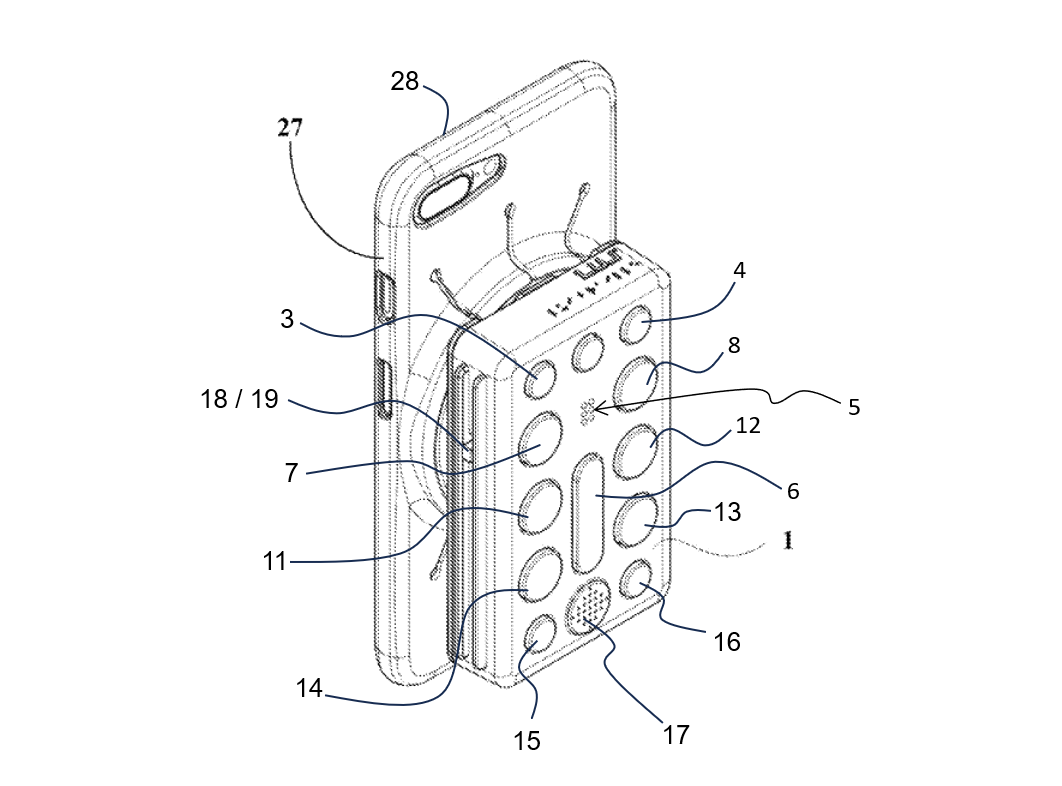
With reference to the illustrated embodiment above, the patent claims:
- an assistive electronic system for visually impaired users, comprising: a Braille reader-writer (1), which includes:
- a keypad located on the front face of the Braille reader-writer and having at least a “Space” (6); “Backspace” (4); “Enter” (3), and six Braille dots (7, 8, 11, 12, 13, 14) for a visually impaired user to input characters including Braille dot characters.
The Braille reader-writer further includes:
- a communication module for implementing a communication with a smart device (28) to enable the user to input the characters into the smart device via the keypad; and
- a voice module, for issuing voice prompts to help the user input Braille dot characters correctly when the communication is not implemented – the voice prompts optionally being played through a speaker (17).
Lastly, the reader-writer also includes a refreshable Braille display (5) – a distinguishing feature explained further below.
Examination: The refreshable Braille display:
During examination, the Examiner cited Korean patent application KR1020200076462A, which disclosed the key features of the claimed Braille reader-writer, including smartphone communication and voice prompt functionality. By incorporating the feature “a refreshable Braille display (5)” into the main claim, the applicant overcame the novelty objection and obtained a UK patent without a further examination report being issued.
This illustrates how a carefully targeted claim amendment can distinguish an invention from the cited prior art while avoiding further rounds of examination.
According to the disclosure, embodiments including the Braille display (5), for example, “on the front face of the Braille reader-writer provides a tactile device that consists of a series of small pins, arranged in 3 rows and 2 columns, where each pin represents a Braille dot.
These pins can be raised or lowered electronically to form Braille characters in real time, whereby the visually impaired user may feel the raised pins with his/her fingers to better understand or confirm the Braille dot character inputted by the user” [1].
This allows users to verify their input through tactile feedback in real time, reinforcing learning while reducing input errors.
Additional features:
Beyond the core invention, the specification also describes several optional embodiments including a mode selection switch (18) for selecting one of a Braille letter learning mode, a Braille number learning mode and the braille keyboard mode as the current working mode of the Braille reader-writer.
Optionally, a smart device adapter (27) may be used to facilitate physical coupling of the smart device (28) to the back face of the Braille reader-writer. This approach may enable the assistive device to leverage the computing power and accessibility features already available on modern smartphones rather than duplicating them.
The patent further discloses that the adapter may have a body for tightly wrapping the Braille reader-writer to the back of the smart device via locking teeth and sliding tracks as well as a rotatable component for adjustability during use.
Quite remarkably, the system may include a gamepad sleeve adapted to connect wirelessly to the smart device while physically attached to the Braille reader-writer, indicating that this device is intended to not only facilitate Braille learning and communication with smart devices, but also provide an integrated platform for education, productivity and entertainment.
Few assistive technologies seek to integrate learning, communication and recreation within a single portable platform, making this one of the more distinctive aspects of the invention.
Read the full patent here
Did you know?
According to the World Health Organization, around 90% of people with visual impairment live in low and middle-income countries, where access to Braille education and assistive technologies may be limited, a challenge recognised in the background section of this patent [1].
In RNIB’s Braille 200 research, more than six in ten respondents described themselves as advanced or expert Braille users, with many reporting that Braille improved their independence, employment opportunities and education [2].
Many pedestrian crossings in the UK also incorporate rotating tactile cones on the underside of the push-button unit. When it is safe to cross, the cone rotates, allowing visually impaired pedestrians to determine when the green crossing phase is active through touch alone, without needing to see the traffic signals or rely on an audible indicator.
Further, pharmaceutical companies are increasingly required to include Braille for the product name and strength on the packaging of many medicines, and it is also not unusual to find Braille indicating an item’s use-by or sell-by date.
These examples demonstrate both the global need for accessible Braille technologies and the continuing importance of innovations that promote independent learning, communication and independent living.
References:
[1] UK Granted Patent, GB2700473B – An assistive electronic system for visually impaired users – https://www.search-for-intellectual-property.service.gov.uk/GB2503252.5/documents
[2] Braille 200 report: Benefits and opportunities for people in the UK – https://www.rnib.org.uk/professionals/research-and-data/reports-and-insight/braille-200-report/
The Patent Eye blog offers a glimpse into the future by showcasing newly granted patents. Join us as we explore the latest innovations shaping our world.
The Patent Eye blog is made available by Alphabet Intellectual Property for informational purposes, in particular, sharing of newly patented technology from granted and published patents available in the public domain. It is not meant to convey legal position on behalf of any client, nor is it intended to convey specific legal advice.
Craving intellectual stimulus? Peer into the insights brought to you by The Patent Eye and explore our latest articles.