

 GB2629844B
Introduction:
On 9 September 2026, Protego Sports Ltd was granted UK patent GB2629844B titled Mouthguard, commonly used to prevent injuries in contact sports including rugby and boxing [1].
Technical Problems:
According to the patent, it is not just the discomfort of wearing a mouthguard that may present issues, but also that breathing may be impaired adversely affecting sporting performance.
The Patent:
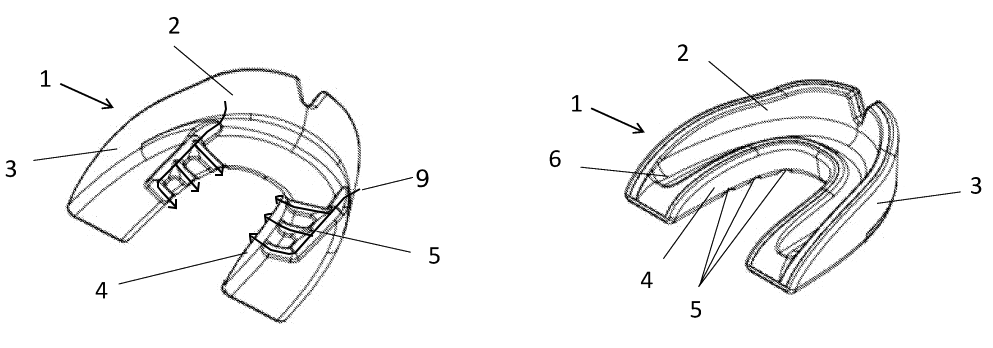
With reference to the illustrated embodiment above, the patent claims a mouthguard (1) comprising:
- a one-piece, main body (2) portion configured to fit around the teeth of the upper or lower jaw, with an outer surface (3) outward of the teeth and an inner surface (4) inward of the teeth, thereby to protect the teeth from impact;
- the main body (2) portion further comprises a plurality of air channels (5) that extend between said outer and inner surfaces of the mouthguard, thereby to facilitate the passage of air (9) between the outside of the teeth and the inside of the teeth;
- wherein the air channels comprise a single air channel leading from the outer surface, which branches into at least two air channels leading out of the inner surface.
The main body may include a laminated thermoplastic polymer.
How the Invention Improves Airflow:
According to the patent prosecution, the branching arrangement of the air channels is intended to improve the flow of air into and out of the mouth. In particular, the channels are designed to allow air to be drawn through the front of the mouth, closer to the incisors where the teeth engage with the mouthguard, and delivered directly into the mouth cavity.
This is particularly relevant when the wearer clenches their teeth. During sporting activities, athletes may naturally bite down on a mouthguard, leaving little space between the upper and lower jaws for air to enter or leave the mouth. The air channels can provide dedicated pathways for air to pass through the mouthguard, allowing airflow to continue even when the jaws are closed.
The branching configuration is a key aspect of the design because it provides multiple pathways for airflow through the mouthguard. Rather than relying on a single uninterrupted passage, air entering through the outer surface can be divided between multiple channels leading towards the inner surface. This can help maintain airflow when the mouth is fully closed and the available space around the teeth is limited.
The arrangement may also help address differences in individual dental anatomy. Every wearer has variations in the size, shape and alignment of their teeth, which can affect how a mouthguard sits within the mouth and how readily air can pass through it. By providing multiple branched pathways, the design can provide a degree of redundancy, such that if one pathway becomes partially obstructed by a tooth or surrounding tissue, other pathways may remain available for airflow.
Another important aspect of the design is the location of the air channels within the mouthguard. The channels are integrated into the rigid internal structure rather than the outer gel layer (6) that is moulded around the wearer’s teeth. The gel layer is designed to conform to the individual’s dental anatomy, providing a secure and comfortable fit, but its ability to deform during fitting also means that its shape can change as the mouthguard adapts to the teeth.
If the air channels were located within this mouldable layer, their shape and dimensions could be altered or partially obstructed during fitting, potentially compromising airflow. By incorporating the channels into the non-mouldable core of the mouthguard, their geometry can remain substantially consistent while the surrounding gel layer adapts to the wearer’s teeth. The design is therefore intended to provide more reliable airflow while retaining the benefits of a customised fit.
Additional features:
Beyond the core invention, the dependent claims include a respective arrangement of the air channels on each side of the main body portion, in a symmetrical relationship to one another about a central axis of the main body portion. Further, each arrangement of air channels may include the single air channel leading from the outer surface, which branches into three air channels leading out of the inner surface.
Optionally, the air channels may include a groove formation, cut into a lowermost surface of the main body. The groove formation may have a substantially C-shaped section.
In another embodiment, the air channels may extend from the outer surface and pass through a portion of the main body configured to engage, in use, with incisors, and in another embodiment, with molars.
Optionally, the main body includes a gel layer, as mentioned previously, between the outer surface and the inner surface, configured to engage in use with the teeth of the upper or lower jaw, to further protect the teeth from impact. The gel layer may include a thermoplastic polymer that softens when heated and stiffens when cooled.
Read the full patent here
Did you know?
Concerns about the long-term effects of head trauma in contact sports have become increasingly prominent. In rugby, particular attention is being given to player welfare and the potential consequences of repeated impacts to the head, including injuries that may not be immediately apparent and the cumulative effects of concussion.
This issue has also led to increasing legal action against rugby’s governing bodies in the UK, with almost 300 former players reportedly pursuing claims relating to brain injuries.
The claims include allegations that the governing bodies did not do enough to reduce the risks associated with repeated head impacts or adequately safeguard players from the resulting injuries [2].
References:
[1] UK Granted Patent, GB2629844B – Mouthguard – https://www.search-for-intellectual-property.service.gov.uk/GB2307058.4/documents
[2] Rugby’s concussion problem tackled by smart mouthguards – https://www.bbc.co.uk/news/uk-northern-ireland-67441501
The Patent Eye blog offers a glimpse into the future by showcasing newly granted patents. Join us as we explore the latest innovations shaping our world.
The Patent Eye blog is made available by Alphabet Intellectual Property for informational purposes, in particular, sharing of newly patented technology from granted and published patents available in the public domain. It is not meant to convey legal position on behalf of any client, nor is it intended to convey specific legal advice.
Craving intellectual stimulus? Peer into the insights brought to you by The Patent Eye and explore our latest articles.