

 GB2644622B
Introduction:
On 23 September 2026, Zeal Innovation Ltd based in Swansea was granted UK patent GB2644622B titled Security devices. The invention relates to ceramic-reinforced security devices, particularly a security device comprising a metallic elongate body with at least one end attachable to a lock unit, in which an operative component is reinforced with cut-resistant material [1].
Technical Problems:
The invention seeks to provide an element that is sufficiently difficult to cut to deter or prevent thieves from breaking a device secured by it. This is achieved by a track that is bonded to a metallic elongate body that has at least one end attached to a lock unit.
The Patent:
The patent claims a security device in which a metallic elongate body (4, 20, 40) has at least one end attachable to a lock unit (24), wherein
- the body has at least one track (8, 22, 38) extending longitudinally on the surface thereof;
- the material of the track having particles of a hard cut-resistant material dispersed in a self-fluxing matrix of lower melting point than that of the body and comprising one of nickel, iron and cobalt in composition with chromium, silicon and boron; and
- the or each track being welded or brazed to the elongate body.
The cut-resistant particles may include at least one of tungsten carbide, silicon carbide, and an industrial or synthetic diamond.
The lower melting point of the matrix helps to limit melting of the elongate body while enabling the bonding process. The patent identifies welding, preferably laser welding, as a suitable technique, although laser cladding, plasma arc welding or brazing might also be used.
How the Invention Improves Security:
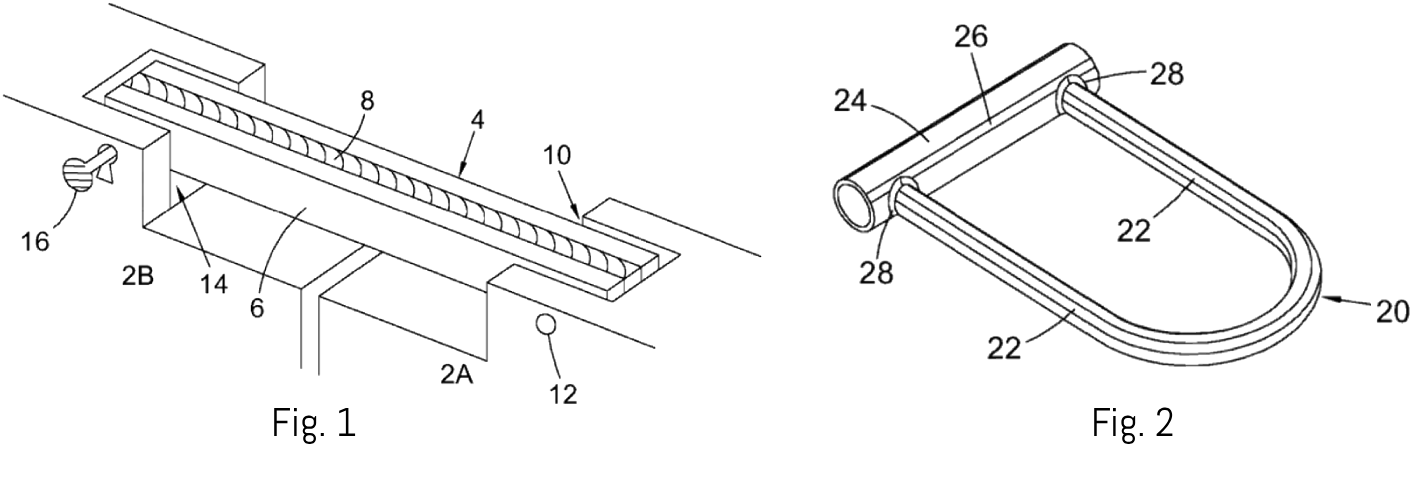
According to the examples in the patent disclosure, and with reference to Figure 1, two housing members (2A, 2B) are shown secured together by a metallic elongate body (4), with a track (8) including a hard cut-resistant material welded thereon. The first end of the body (4) is mounted in a slot (10) for pivotal movement about an axle (12), and the second end of the body (4) is received in a slot (14) where it is held by a locking mechanism operated by key (16).
By reinforcing the elongate body with a track containing hard cut-resistant particles, the invention aims to make the body substantially more difficult to sever using cutting tools, thereby increasing the time and effort required to defeat the locking mechanism.
In another example shown in Figure 2, the body (20), a D-lock for a bicycle, may be reinforced by tracks (22) welded thereto. The locking bar (24), which receives the body at openings (28), may also be reinforced by one or more tracks (26).
The patent discloses a preferred composition of the self-fluxing matrix that includes 15% chromium; 3% boron; 4.5% silicon; 0.65% carbon, and 3% iron, with the balance being nickel, although the matrix would normally also include some ceramic material. This is reflected in dependent claim 2, which specifies that the self-fluxing matrix may also include a ceramic material.
Additional features:
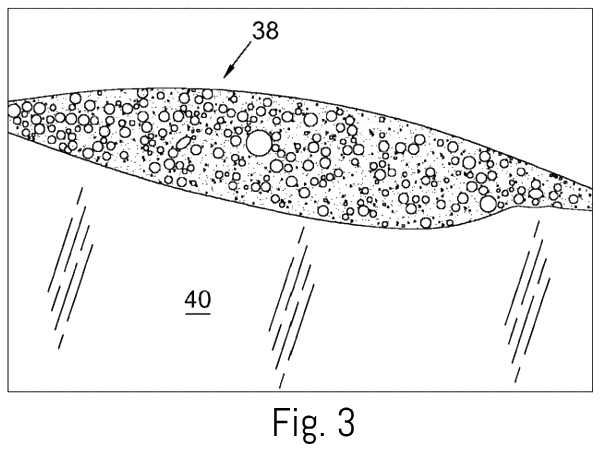
Figure 3 shows a bond between a track (38) and an elongate body (40), with tungsten carbide particles dispersed in the track matrix. According to the patent, although the particles are randomly distributed, their concentration is sufficient to provide resistance to attempts to cut through the track. The hard cut-resistant particles dispersed in the matrix may therefore provide the principal reinforcement against cutting.
The cut-resistant particles may be spherical, with sizes between 50 and 160 µm, or cast and crushed, with sizes between 50 and 200 µm. The particles may form 40-65 vol. % of the track material.
Read the full patent here
Did you know?
Conventional hardened steel bicycle locks can be vulnerable to attack using battery-powered angle grinders, which can cut through them in a matter of moments.
In February 2026, the London Cycling Campaign (LCC), in its report Broken Locks, Broken Promises, estimated that around 40,000 bicycles are stolen in London every year. The report also highlighted the low recovery rate, with only around 2% of stolen cycles recovered [2].
With recovery rates so low and portable power tools presenting a significant challenge to conventional bicycle locks, innovations in ceramic-reinforced security devices aim to make cutting through locks more difficult and time-consuming, potentially deterring thieves.
References:
[1] UK Granted Patent, GB2644622B – Security devices – https://www.search-for-intellectual-property.service.gov.uk/GB2307058.4/documents
[2] New report slams “shocking inaction” on bike theft, with just 2% of stolen cycles likely to be recovered – https://road.cc/news/new-report-slams-shocking-inaction-on-bike-theft-with-just-2-of-stolen-cycles-likely-to-be-recovered
The Patent Eye blog offers a glimpse into the future by showcasing newly granted patents. Join us as we explore the latest innovations shaping our world.
The Patent Eye blog is made available by Alphabet Intellectual Property for informational purposes, in particular, sharing of newly patented technology from granted and published patents available in the public domain. It is not meant to convey legal position on behalf of any client, nor is it intended to convey specific legal advice.
Craving intellectual stimulus? Peer into the insights brought to you by The Patent Eye and explore our latest articles.