

 GB2272154B
Introduction:
Editorial Note: Although The Patent Eye traditionally showcases newly granted patents and the latest innovations, from time to time we also revisit older patents that are unusual, intriguing or simply worth a second look.
On 3 November 1993, Patent Examiner D HAWORTH of the UK Intellectual Property Office (‘UKIPO’) searched collections of GB, EP, WO and US specifications to conclude that the number of citations relevant to Edward Thomas Patrick Doughney’s invention relating to a spider ladder, was precisely NONE [3].
Prosecution History:
On 12 August 1993, Edward Doughney filed UK Patent Application no. GB9318057.8 titled “Spider ladder provided with means for attachment to an item of sanitary ware” at the UKIPO. The application benefitted from an earlier priority filing, GB9222883 filed 31 October 1992 (which coincided with Halloween).
The Patent:
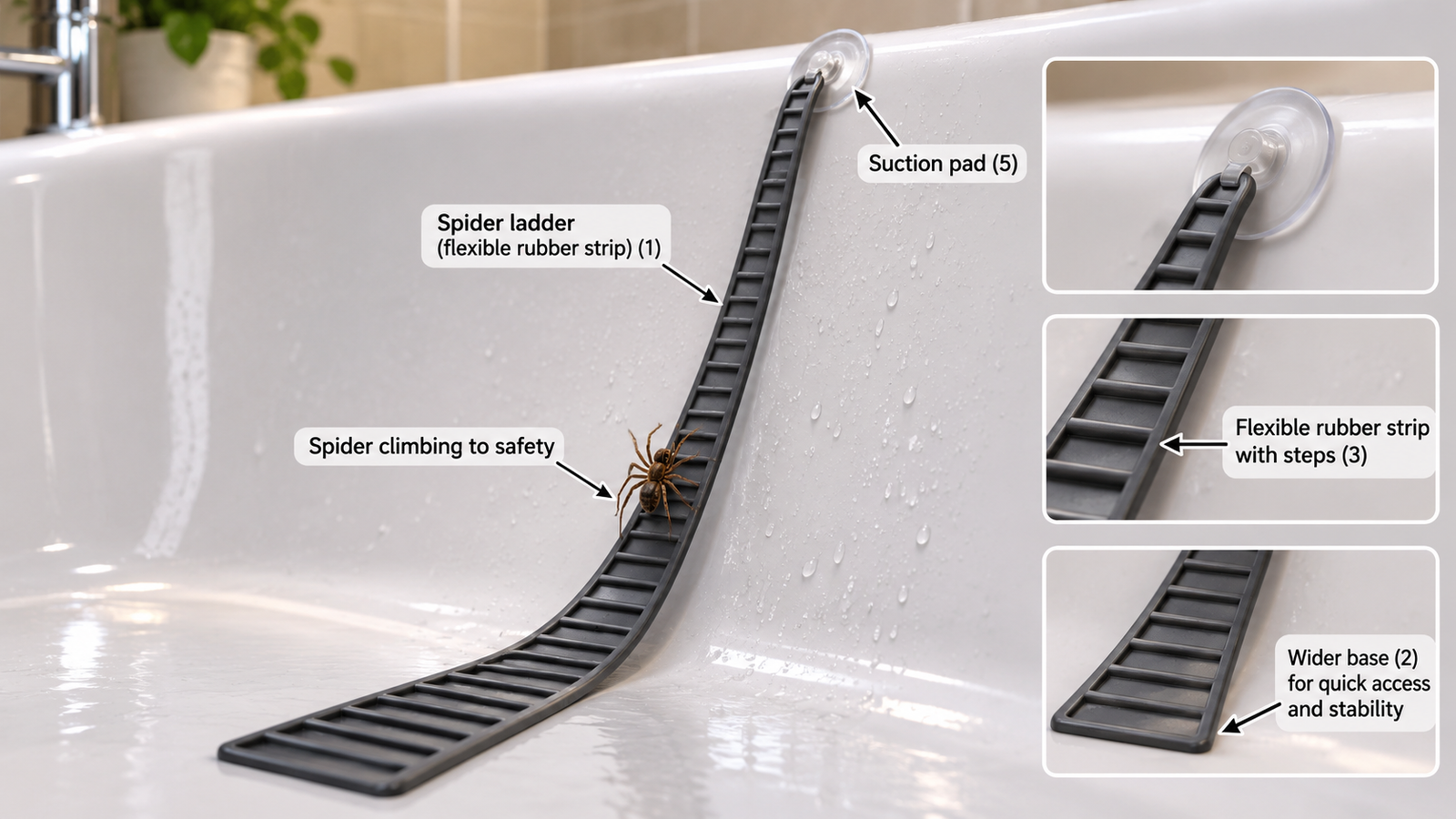
With reference to the illustrated embodiment above, the patent claims a spider ladder comprising:
- a thin flexible Latex rubber strip (1);
- means for attaching the Latex to a bath, a basin or sink;
- inner (2) and outer steps (3); and
- a wide base.
Optionally, a Suction Pad (5) is provided attached to the Latex strip. The adhesive properties of the Latex rubber strip may enable a spider(s) to scale the ladder.
Dependent claim 4 gives consideration to the nature of species or family of spiders in relation to their preference for colour of the ladder.
The thin flexible Latex rubber strip is flexible and may follow the inner contours of the bath, basin or sink.
How the Invention Helps Spiders:
According to the inventor’s disclosure, the common house spider can be trapped within a bath or basin due to its inability to negotiate or scale the smooth inner contours of a conventional bath or basin. Therefore, the flexible Latex rubber strip is preferably made from rubber or plastic, and to prevent slipping, consideration is given to the adhesive properties of the material chosen, to assist the spider.
In the exemplary embodiment, the means for attaching the Latex to a bath, a basin or sink is given as the suction pad (5), positioned on or near the top edge of a bath or basin and the ladder is allowed under gravity to follow the inner contours of the bath or basin until the free end is positioned at the inner base.
The thickness (4) of the rubber which surrounds the suction pad may provide added strength to the suction pad base.
Search Classifications:
Under the International Patent Classification (IPC) and Cooperative Patent Classification (CPC), the relevant classes were identified in search and examination of this invention, as A47K17/00 (Other sanitary equipment); E06C1/52 and E06C1/56 (ladders with non-rigid longitudinal members).
However, the UKIPO also identified under UK Classification, the groups A4N N8X, referring to the technical field index for Baths, closets, urinals, and sanitary fittings; and E1S SLS5, typically relating to domestic plumbing, sanitary equipment, or bathroom installations.
These classifications give us an insight into the technical fields in which the Examiners considered relevant prior art might be found. Interestingly, despite the unusual nature of the invention, the classifications span only a relatively narrow range of sanitary equipment and ladder-related categories. For similar reasons, we’ve placed this article in the closest of our categories in The Patent Eye blog, Lifestyle!
Following examination, the patent was granted as GB2272154B on 1 May 1996. On 12 August 1997, the renewal fee for the fifth year was paid at the UKIPO, and for the next nine years, renewal fees were also successfully paid meaning that the patent remained in force in the UK for 14 years until the proprietor appears to have had a change of heart about the overall business model. Read our latest article on Renewal fees in The Patent Alphabetical.
Read the full patent here
Did you know?
Spiders belong to a separate class of animals called Arachnids, while insects belong to the Class Insecta, which includes, for example, ants.
In the Holy Quran, Chapter 29 is named Al-Ankabut (which means “The Spider” in Arabic). While this chapter is not fundamentally about spiders in substance, it is named as such because of a single famous parable recounted in verse 41. These passages from the Quran offer different perspectives on the awareness and consideration given to even the smallest of creatures.
In another example, in Chapter 27, verses 18 and 19 of The Holy Quran, a dialogue between an ant (Naml) and her colony of ants (Namlites) is heard by Prophet Sulaiyman (as) (Solomon), wherein the ant instructs the “Namlites” to seek refuge or be crushed by Sulaiyman and his army [1].
حَتَّىٰٓ إِذَآ أَتَوْا۟ عَلَىٰ وَادِ ٱلنَّمْلِ قَالَتْ نَمْلَةٌ يَـٰٓأَيُّهَا ٱلنَّمْلُ ٱدْخُلُوا۟ مَسَـٰكِنَكُمْ لَا يَحْطِمَنَّكُمْ سُلَيْمَـٰنُ وَجُنُودُهُۥ وَهُمْ لَا يَشْعُرُونَ [27:18]
English Translation: “Until when they came to the valley of the Naml, a Namlite said: O Naml! enter your houses, (that) Sulaiyman and his hosts may not crush you while they do not know.” – [Chapter 27, verse 18].
فَتَبَسَّمَ ضَاحِكًا مِّن قَوْلِهَا وَقَالَ رَبِّ أَوْزِعْنِىٓ أَنْ أَشْكُرَ نِعْمَتَكَ ٱلَّتِىٓ أَنْعَمْتَ عَلَىَّ وَعَلَىٰ وَٰلِدَىَّ وَأَنْ أَعْمَلَ صَـٰلِحًا تَرْضَىٰهُ وَأَدْخِلْنِى بِرَحْمَتِكَ فِى عِبَادِكَ ٱلصَّـٰلِحِينَ [27:19]
English Translation: “So he smiled, wondering at her word, and said: My Lord! grant me that I should be grateful for Thy favor which Thou hast bestowed on me and on my parents, and that I should do good such as Thou art pleased with, and make me enter, by Thy mercy, into Thy servants, the good ones.” – [Chapter 27, verse 19].
When Prophet Sulaiyman (as) with his large army of men, jinn, spirits and animals entered a valley where several thousand ants were carrying on their daily routine on the surface of the earth, they at once decided to enter into their holes inside the earth so that they might not be inadvertently crushed by the hosts of Sulaiyman (as).
According to Imam Ja’far bin Muhammad as Sadiq (as) there were large deposits of gold, silver and other very useful metals in that valley [2].
As Sulaiyman (as) was given supernatural powers, he understood the language of the ants and ordered a halt to his hosts until the ants clear the way.
The ant is a very small and humble creature, yet they are given necessary intellect to manage their lives in orderly manner by doing that which is useful and avoiding that which is harmful. In spite of his great kingdom and supernatural powers, Sulaiyman (as) humbly prays that his power and wisdom and all other gifts may be used for righteousness and for the benefit of all around him.
Whatever Edward Doughney’s perspective when filing his Spider Ladder patent application, the fact remains that consideration was given to a small and humble creature, and there is something mystical and powerful about the awareness involved!
References:
[1] The Holy Quran – https://quran.al-islam.org/
[2] Commentary on The Holy Quran – Agha Mahdi Pooya – https://quran.al-islam.org/
[3] UK Granted Patent, GB2272154B – Spider ladder provided with means for attachment to an item of sanitary ware – https://worldwide.espacenet.com/patent/search/family/026301897/publication/GB2272154B?q=pn%3DGB2272154
The Patent Eye blog offers a glimpse into the future by showcasing newly granted patents. Join us as we explore the latest innovations shaping our world.
The Patent Eye blog is made available by Alphabet Intellectual Property for informational purposes, in particular, sharing of newly patented technology from granted and published patents available in the public domain. It is not meant to convey legal position on behalf of any client, nor is it intended to convey specific legal advice.
Craving intellectual stimulus? Peer into the insights brought to you by The Patent Eye and explore our latest articles.